
Search has quietly changed shape over the past couple of years, and most small business owners haven’t caught up yet. People once typed a question into Google and scrolled through a list of blue links to find an answer, but now an AI tool often gives them that answer before they click on anything.
The future of search engine optimization isn’t just about rankings anymore; it’s about how AI tools are reshaping how customers find your business in the first place. That’s exactly what this guide breaks into plain terms.
Why Search Behavior Is Shifting So Fast
Search engines aren’t just ranking pages anymore; they’re answering questions directly. Tools like ChatGPT, Google AI Overviews, and Perplexity now summarize information and hand it to users without requiring a single click. According to AI search statistics by Gartner, traditional search traffic is expected to decline by 25% by 2026 as more users turn to AI-powered search tools for instant answers. With AI platforms influencing how customers discover brands, small businesses need to optimize their content for Answer Engine Optimization (AEO) alongside traditional SEO strategies.
A growing share of searches now end without anyone visiting a website. As shown in the same research, over 60% of Google searches end without a click to a third-party site, and this rise in conversational search optimization means people get full answers through natural questions instead of clicking through a list of links.
Small businesses often assume this trend only affects big brands, but that’s not true. Local service businesses appear in AI answers just as often as national chains, and sometimes more so when the question is specific to their area. As a recognized Designrush Partner, we know that falling behind here means losing visibility at the point where future customers start their search.
What Is AEO in Digital Marketing?
AEO means Answer Engine Optimization. In digital marketing, it is the practice of making useful, accurate information easier for search and AI-powered systems to understand and present in direct answers. The AEO meaning in SEO is an extension of familiar work on content quality, crawl access and clear page structure, with added attention to how your business is described or cited in answers. It does not guarantee inclusion in an AI response.
How AEO Actually Works
AI tools scan the web for content that clearly and confidently answers a question. This means structuring and formatting your content so AI tools like ChatGPT, Perplexity, Google AI Overviews, and voice assistants can easily understand, trust, and use it as a direct answer. The clearer your answer, the better your odds of getting picked up.
Why It’s Different From Just Writing Good Content
Good writing on its own doesn’t guarantee AI tools will notice you. Your content needs a clear structure, with direct definitions, organized headings, and answers that make sense on their own without needing the rest of the page for context. That’s a different skill than writing a long blog post meant to keep people scrolling.
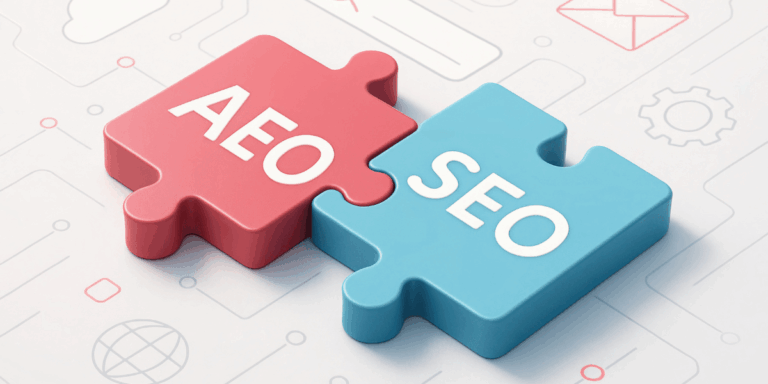
Answer Engine Optimization (AEO) vs SEO: Where They Overlap
AEO didn’t appear out of nowhere, and it relies heavily on SEO basics that already work. Studies show that 99% of links shown in AI search results also appear in the top 20 regular search results, which tells you strong SEO and AI visibility go hand in hand. A site with weak SEO rarely gets picked up by AI tools either.
Examples of Answer Engines in Action
Answer engines now span a whole group of tools, not a single platform. This includes ChatGPT Search, Perplexity AI, Google AI Overviews, Google AI Mode, Claude, Gemini, Microsoft Copilot, and Meta AI. Each one pulls information a little differently, but they all favor content that answers questions clearly.
SEO Still Matters, Not Alone Anymore
Traditional SEO hasn’t disappeared, and it’s not going to be replaced any time soon. It’s becoming one half of a larger picture rather than the whole picture.
What Traditional SEO Still Delivers
SEO drives the consistent organic traffic that businesses depend on every day. It still controls how your website ranks for keywords, how fast your pages load, and how easily search engines can crawl your site. None of that becomes irrelevant just because AI answers exist.
Why Rankings Alone Aren’t Enough
Ranking well used to mean people would click through to your site. Now, a high-ranking page might be summarized into an AI answer without a single visitor landing on it. That changes how you should measure success.
What’s Genuinely New With AEO
AEO introduces a different way of thinking about content, one built around direct answers instead of long narratives. The goal of traditional SEO is to drive organic traffic by relying on how well your content satisfies search engine algorithms and how effectively it matches user queries, while AEO is about optimizing your content so AI models can easily understand and accurately present it in their responses.
Why You Need Both Working Together
Neither strategy replaces the other, nor does treating them as competitors miss the point entirely. SEO drives the organic traffic that pays the bills today, while AEO builds the brand authority that protects your visibility as AI search grows. A business that focuses only on one risk is likely to lose ground to the others.
SEO and AEO for Small Businesses: A Practical Strategy

Building a solid AEO approach starts with the content you already have. It’s mostly about presenting that information in a clearer, more direct way.
Lead With Direct Answers
Every section of your content should open with a clear, direct answer before adding supporting detail. AI tools tend to pull the first few sentences of a section, so burying your main point under three paragraphs of introduction works against you.
Use Clear Headings That Match Real Questions
Write your headings the way people actually ask questions out loud. This helps both readers and AI tools understand exactly what each section covers, making your content far easier to extract and summarize accurately.
Add Structured Data Where You Can
Schema markup helps AI tools understand what type of content they’re looking at, like an FAQ, a review, or a how-to guide. Adding structured data markup when possible explicitly labels content types like FAQs, products, or reviews for both search engines and AI tools.
Keep Facts Verifiable and Specific
Vague claims don’t get picked up nearly as often as clear, checkable facts. Numbers, dates, and specific details give AI tools something concrete to draw on, rather than skipping over your content. The more precise your facts are, the easier it becomes for an AI tool to trust and quote them.
Build Topic Authority Over Time
One good page on its own rarely beats a website that covers a topic in real depth. Building out a group of related content around your main services helps both search engines and AI tools see you as an authority on the subject.
Conversational Search Optimization Is the Future
People are now talking to search tools in full sentences and natural questions, not typing short keyword fragments.
Why People Search Differently Through AI
Someone typing into Google might search for “best plumber near me,” but the same person talking to an AI assistant might ask, “Who’s a reliable plumber near me that can come out today?” That shift toward natural language changes what content actually gets matched and cited.
Writing for How People Actually Speak
Content built around natural, conversational phrasing performs better in this environment. Answering the exact way a real person might ask a question, rather than the shorthand version typed into a search bar, increases your odds of getting picked up by AI tools.
Digital Age helps businesses in Colorado Springs rebuild content around how people are actually asking questions today, bringing years of hands-on experience as a digital marketing company in Colorado Springs. That experience translates into content that performs across both traditional rankings and AI-driven answers.
What Is AEO vs SEO?
SEO focuses on making your website discoverable and useful in organic search results. AEO focuses on whether your information can help answer a specific question in a search feature or AI experience. The same page can support both: a service page might rank for a local search and explain a service clearly enough to be cited in an answer. Strong rankings do not guarantee an AI citation, and a brand mention does not necessarily produce a website visit.
Answer Engine Optimization for Small Business: Where to Start
AEO for small business works best when it starts with actual customer questions. Choose one important service page, explain who the service is for, describe your service area and process, and answer common questions about cost factors, timing and suitability. Use accurate business details, relevant internal links and evidence for factual claims. Keep the answers helpful to people rather than repeating keywords in every section.
For example, a Colorado Springs service business could explain which neighborhoods it serves, how customers book and what happens during an appointment. Measure relevant organic clicks and enquiries alongside a consistent sample of AI questions. This keeps SEO and AEO for small businesses connected to customer demand and business outcomes.
Is Answer Engine Optimization the Best Approach for AI-Driven Platforms?
AEO is a useful part of a search strategy, but there is no single best approach for every AI platform or market. Start with accessible pages, original expertise, clear answers and consistent business information. Then identify the questions your audience asks and review which sources appear. Different systems can return different answers, so assess patterns rather than treating one response as proof of success.
If your goal is visibility in the AI market, combine AEO with technical SEO and relevant authority-building. A tool or agency should explain which platforms and questions it monitors, how often it checks them and how it distinguishes mentions, citations and referral traffic. Prioritize improvements you can implement and measure.
Do You Need a Separate AEO Tool if You Already Use an SEO Platform?
Not automatically. If you already use a traditional SEO platform and are considering a separate AEO tool like Suede, first check whether your existing plan answers the questions you need: which AI systems mention your business, which pages they cite, and how those observations change across relevant prompts. A product name alone is not a reason to add another subscription.
Consider a separate tool only when it fills a specific reporting or workflow gap at a sensible cost. Compare current platform coverage, prompt and location controls, repeat-check methods, export options and reporting limitations through a demonstration or trial. This is a selection checklist, not a claim about Suede’s current features. A small business can begin with a documented set of manual checks, Search Console and analytics before paying for additional monitoring.
Conclusion
Search isn’t splitting into two separate worlds; it’s expanding into a single approach that rewards businesses that do both well. SEO still drives the traffic that keeps a business running day to day, while AEO determines if your expertise gets cited the moment someone asks an AI tool a direct question. The future of search engine optimization favors small businesses that adapt their content now, putting themselves in a stronger position to stay visible no matter how someone searches.
Digital Age is a digital marketing company offering AI SEO services in Colorado Springs that help small businesses build a search strategy covering both traditional rankings and AI-driven answers. Contact us today!
Frequently Asked Questions
- What is Answer Engine Optimization (AEO) and how is it different from SEO?
AEO is about earning a direct citation inside AI-generated answers, while SEO is about getting your web pages to rank in traditional search results. They work toward different goals but rely on many of the same foundational practices.
- Do small businesses need AEO in 2026?
Yes, since AI tools increasingly answer questions for local and niche searches just as often as broad ones. Small businesses that overlook AEO risk slipping out of sight just when customers are searching for their services.
- Can AEO and SEO work together?
They’re meant to work together rather than compete. A strong SEO foundation supports AEO success, since AI tools tend to pull from content that already ranks well organically.
- What type of content works best for Answer Engine Optimization?
Clear, direct answers organized under specific headings tend to perform best, along with FAQs and structured data that help AI tools understand exactly what your content covers.
- How long does it take to see results from AEO?
Results depend on your starting visibility, content, competition and the systems being checked. There is no reliable universal AEO deadline. Record a baseline, log changes and repeat relevant prompt checks over time, while tracking referrals and qualified enquiries separately.

Muhammad Asjad Khan is a seasoned digital marketer and the Chief Operating Officer at Digital Age, where he leads strategy, innovation, and client success. With years of experience in SEO, content marketing, and performance-driven digital campaigns, Asjad is passionate about helping brands grow their online presence and achieve measurable results. When he’s not optimizing websites or scaling marketing strategies, he’s exploring the latest trends in tech and digital media